Tampilkan postingan dengan label Music Tips. Tampilkan semua postingan

Senin, 06 Juli 2015

Advice for Pianists


1) Start With the Melody
You don't have to come to the piano with an entire song already in your head before you start composing. Just start with one simple melodic phrase. That melody will be the centerpiece for everything else in your composition. It's the foundation and the focal point of your piece. As you begin to compose, improvise on that melody and see where it naturally wants to take you. The musical place it leads you to is usually your 'hook', or what I'll refer to in this article as your chorus. Think of your chorus as your melodic destination.
2) What is Your Song About?
As you develop your overall melody, think about the emotion or image you want your composition to convey. What is the song's message? Is it love? Faith? Winter? Water? Whatever your song message is, keep it in the forefront of your mind as you compose. Doing so will influence the direction the composition takes. I find it helps to give the composition a name early in its development. Then the song title becomes the 'goal' you're working toward, in a manner of speaking.
3) To Intro or Not to Intro?
It is sometimes tempting to write a long introduction (something I'm guilty of) to 'set the mood' for your composition. Be careful with this. Remember, the melody is (typically) what makes or breaks your song. It is also the device that holds the various elements of your composition together. Finally and most importantly, the melody is the part of your song your listener will remember. So, get to the melodic point quickly, and don't linger too long on your introduction. People don't generally hum introductions to themselves - they hum melodies.
4) The Anti-Melody Song?
Some compositions are just 'mood' pieces. I have a few of these, which don't really have a melody so much as cool, ambient sense about them. There's nothing wrong with writing mood pieces, but be warned, you can only carry a 'mood' for so long before the listeners ear tires. Keep your mood pieces relatively short. Under 3 minutes is a good, general rule. Most of mine are about 2:45.
5) Follow the Muse
t's not uncommon to find that while you're developing a composition, you find yourself taken into an entirely new musical direction. The question to ask yourself is, does this 'new direction' belong with your original melody? Or, have you accidentally stumbled upon a new, second melody better suited for an entirely new composition? A great number of my songs originated as spin-offs of other compositions. So if you have a great melody and it takes you to a second great melody, consider whether you're might really be working on two different songs and whether you need to split them apart so they can 'play' in their own separate worlds.
6) Repeat with Style
Once you have firmly established your melodic phrase and chorus, don't pound them into the ground. You might play your melody twice the same exact way, but by the third time you ought to be embellishing it so that even though it's the same melody, it sounds different. That might mean playing it in a different octave, adding more bass, more flair, or a slightly different rhythm. However you do it, enhance the melody throughout the piece. Don't let it grow stale or your beautiful melody will begin to grate on your listeners' ear.
7) Build Slowly, but Build Something.
Whatever you do, do something with your song. Remember, you're telling a story with your music, so arrange your song in such a way that it keeps moving in a particular direction. When you read a storybook to your kids before bedtime, you don't read page one, read page two, then go back to page one again, and then read page two, read page two, and read page two once more. Your kids would get really bored! With each new page, the story needs to advance toward the happy ending, in proper order. Do the same thing with your music. Every 'page' of your composition should develop your storyline a bit more, building to a gratifying conclusion.
8) Mistakes Count
Don't fret too much about making mistakes as you develop your song. Mistakes can lead to some very cool sounding chords. More than once I've played the wrong notes and then thought, "Hey, what a switch, that sounds cool!" Your "mistake" might end up being the very twist you need at the end of your song to add spice to your tune. When I first start composing a song, I make a LOT of mistakes. It's just part of the process. Music composition is like pottery. You start out with a dirty blob (an idea) and you mold it into something. The process isn't always pretty, but In the end, with persistence and skill, you may end up with something beautiful.
9) Change is Good
After you've developed your melody, you'll need to change things up a bit to keep the listener interested. The 'change up' might be a secondary melody, though it's usually not as strong as the primary melody or chorus.
One of the reasons I think people enjoy my compositions is that they are basically songs. I write them to be, for lack of a better description, songs without words (sorry for the cliché). Every one of my songs has a song-like pattern to it. For example, listen to 'One Night at Mozart's', one of my more popular songs. Here's the pattern:
  • A) Melody established (Intro)
  • B) Chorus
  • C) Bridge
  • A) Melody (Octave lower with embellishment)
  • B) Chorus
  • C) Bridge
  • D) Change Up
  • B) Chorus to End
and there you have a 3 minute song. Notice how simple the structure is?
Let's look at another composition. This time, 'No More Tears.
  • * Intro to set the mood, then...
  • A) Melody
  • B) Chorus
  • A) Melody (with embellishment)
  • B) Chorus
  • C) Change Up
  • B) Chorus
  • A) Melody (octave higher) to end.
Do you see the structure of the songs? Every song is a bit different. Some songs are as simple as "A" and then "B". The point is, a composition is a song. Give it a song-like structure and...
10) Keep it Simple
The biggest mistake I hear in others' composition is over-complexity. For some reason, beginning composers try to make things complicated - as if bigger is better. Part of this, I think, is the need to impress others, and part of it is the mistaken assumption that the more complex a song is, the more significance it has in the overall scheme of life. No, no no. Simplicity is the key to beauty.Clarity is the key to perfection. Don't try to write a song that will impress and don't try to write a song of significance. Just find a simple melody, develop it, give it a twist, and finish it. You should be able to do it in less than 4 minutes. If you have a song over five minutes, examine it closely. You might be doing too much.
I know a very talented pianist who writes incredible melodies, but his songs are way too long. It drives me crazy, because if he'd just simplify his arrangements, his CD would be a thing of beauty. I won't name him, of course, but just look at this song arrangement:
  • A) Melody (Intro)
  • A) Melody (Repeated)
  • B) Chorus (simple version)
  • C) Bridge
  • A) Melody
  • B) Chorus (simple version)
  • C) Bridge
  • A) Melody
  • D) Change Up
  • B) Chorus (complex version)
  • C) Bridge (with embellishment)
  • D) Change Up (with much embellishment, turns into a vamp)
  • B) Chorus (with much embellishment)
  • A) Melody
  • B) Chorus (simple version)
  • C) Bridge
  • A) Melody (to end)
The song runs at six and a half minutes. While the song has one of the most beautiful melodies I've ever heard, the artist plays it into the ground. By the time you're five minutes into the song, you're really wishing it was over.
Keep it simple.
11) Let Time Have its Way
Realize that it might take years to complete a piece. Now and then, I'll write a song in two hours flat, but that hardly ever happens (like maybe 4 times in 20 years). Most of my songs take 6-9 months to complete, and some songs have taken years to finish. If it takes you awhile to finish your composition, don't get frustrated. If you need to, set the composition aside for awhile and come back to it later. Sometimes if you take a couple months off of a song, then come back to it, you'll find it easier to actually finish it.
12) Get a Digital Recorder
Finally, have a digital recorder of some sort right beside you so you can record your ideas while you're still sitting at the piano. There's nothing more frustrating that having a great idea, getting interrupted, and then forgetting it. With a recorder handy you can take the two minutes you need to record a rough-draft of your melody and come back to it later if need be.
There you have it.
-Bagas 
Read more »

Tips How To Be Inspired In Producing Music


1. Loosen The Grip On Your Mind

If you occasionally beat yourself up for not coming up with something the way it sounded in your head, you’re not alone. The way we hear things in our mind and the way we interpret that thought into our music are nearly always going to be different. This IS a good thing. Allow your inspiration to come through your music in a way you weren’t expecting. It keeps it interesting, fresh and can spark a lot more inspiration.

2. Start Before You Think

Often referred to as “on the fly”, being spontaneous can sometimes kick-start your imagination in a big way. Dropping in a random loop, off beat percussion or quick melody and building a track around that regularly leads to something worth saving. Sometimes, getting stuck with a particular sound, VST or genre can quickly demotivate you in making another track.
3. Remix

Remixes (and bootleg remixes) are great ways for producers to gain some attention. They are also great for breaking free from the ‘freak out’ that can come from seeing a blank canvas. By challenging yourself to remix you will inevitably fuel your inspiration and at the same time learn how other producers construct their songs.

4. Humour Yourself

Got Cheese? Humour is a great way to break up an uninspiring production. Open a new project, lay down some random samples and add some humour either in the form of funny recorded vocals or cheesy sounding synths. Sure it may not be a track you ever show anyone else, but it might just be the kick* you need to jump into the next project with a clear mind. *Pun intended

5. Lay It Out

Some producers may struggle with melodies, while others may struggle with the layout of a track. Whatever your hurdle, laying out a track from another artist you admire may just help you overcome that obstacle. While I don’t recommend copying another artists work, I do recommend gaining inspiration from the way in which they have crafted their sounds, started their breakdowns, changed the riffs and fleshed out their layers; Which may help you get past those technical issues that can block creativity.

6. Enjoy Your Production Space

Most artists will tend to have one main space to which their productions are born. Allow this space to be a place that inspires you and invites you back each time. Some will find the addition of the Internet to this workspace to be a freeing move which can help break up studio time comfortably, especially in the track rendering down-time. Other additions may be open window lighting, controlled darkness, sound-wall padding, plants, supporting chair and (monitored) alcoholic beverages.

7. Don’t Do Anything

How often have you forced yourself to create something even when you haven’t been in the mood? Producing is a very complex process and can occasionally be slowed to a halt with forced creativity. If you don’t feel like making any music, then don’t. While there are moments when you may need to push on through regardless of mood due to project time constraints (#Tip 2), creating a track when your mind isn’t there can often do more harm then good; Leaving you frustrated and annoyed which can alter your positive perception of your production space and musical abilities.

8. Time Constraints Are Good

If you have managed to gain a project with time constraints, think of yourself as a lucky one. Many producers ( usually including yourself at an early point in your career) would love to have the opportunity to be asked by labels and other producers to create original and remix productions for them. Essentially, it’s the next step up from producing tracks and sending them to labels in the hope that they listen to them, let alone sign them. If the time constraints are really eating at you, it might be best to go back to Tip #1 or #2 or contact the label/producer and coming to an alternative arrangement.

9. Allow Yourself The Freedom To Change

Most people do a variety of different projects at any one time in their lives. The same goes for producers, who often pick up the ‘cousin’ craft of DJing. Participating in another activity that occupies your mind for long periods of time can often alter how you produce; Sometimes making it harder to create new tracks. This situation is perfectly normal and may just mean that you are putting inspiration into your other activity and it may take a little while to get back into the mind space needed for new productions. To counter act this situation, you may just need to play out Tip #2 or even #7 until you decide which path should take precedence.

10. Listen, Watch and Attend

Listening to new music, Watching music videos and Attending gigs, concerts and festivals should be a must for every producer. Opening your mind to ‘research’ via the Internet, or in the physical world will impact directly on your productions. As humans, we often emulate what we hear and see, and as most productions fit to a certain style based on genre (Kick, Snare, Perc, Instrument, FX) the visual and aural learning can only benefit your mind and concepts. Add to that the rapid rise of the digital producer taking his productions to a LIVE show purposely blurring the lines from bedroom producer to live act.
-Bagas 
Read more »

Minggu, 05 Juli 2015

The Importance of Bass Guitar


Bass is often one of the most over-looked instruments in a musical group. Many audience members have no idea what a bass even is. Despite this fact, bass is probably the most critical instrument in a group. It is rare to find a performing band without a bass player. As a budding bassist, you should be happy to know there is always a high demand for bassists—especially good ones.

The Responsibilities of the Bass Player
Traditionally, the bass performs two basic and vital functions within a band or group:
Bass provides the rhythmic foundation.
Bass provides the harmonic foundation.

The Rhythmic Foundation
The rhythmic foundation refers to the consistent pulse of the music. A skilled bassist supports the group by providing a good-feeling, steady pulse. Most music that is well received has a steady rhythm, or beat, to it. This is the responsibility and priority of the bassist.

The Rhythmic Pulse
The drummer, when present, also aids in providing the pulse. However, don’t be mistaken that it is the drummer's job to create the pulse and you are only along for the ride. Your sense of rhythm must be very solid and independent of anyone else in the group. Each group member should have good rhythm independently while playing together as a whole.
Your rhythmic skills are the most important thing for you to master as a bassist. It doesn’t matter how perfect your choice of notes is. If your notes are in the wrong place rhythmically, it won't feel or sound right.

The Harmonic Foundation
Most people realize the bass player helps with providing the rhythm. A lot of people don't realize the other important function the bass player — supporting the harmony.
Harmony means together. In music, harmony is the playing of several different notes at the same time. Sometimes one person alone, such as a guitarist or pianist, creates this harmony. Other times several people, such as an orchestra, rock band or a barbershop quartet, create the harmony together.
The bass plays a powerful role in how we hear harmonies. When we hear several notes played at the same time, we hear them all relative to the lowest sounding pitch — the bass note.


As you continue studying music, you will learn that music is comprised of three main elements rhythm, harmony and melody. The bass lays the foundation for two of these three elements. Studying bass means to study rhythm and to study harmony, and the techniques to create them on the bass.
Bass is a very powerful instrument. A good bassist can often rescue a mediocre group, while a bad bassist can easily destroy a great group. Use your bass-playing powers for good, not evil. Learn about rhythm. Learn about harmony.
-Bagas S.
Read more »

Against Internet Piracy


It’s never not legal to download unauthorized music from pirate sites or peer-to-peer file-sharing networks. Examples of P2P file sharing networks that make unauthorized music available for download include: Kazaa, Grokster, WinMX, LimeWire, Bearshare, Aimster, Morpheus, and Gnutella.Y ou can avoid activities that support piracy and hurt the music community. Activites that are illegal can include:
1.     Somebody you don’t know emails you a copy of a copyrighted song. You then email copies of it  to all of your friends.
2.     You make an MP3 copy of a song because the CD you bought expressly permits you to do so. But then you put your MP3 copy on the Internet, using a file-sharing network, so that millions of other file sharers can download it and share it as well.
3.     Even if you don’t illegally share files with others, you join a file-sharing network and download unauthorized copies of all the copyrighted music you want for free from other file sharing members' computers.
4.     You pay a fee to join a file-sharing network that isn’t authorized to distribute or make copies of copyrighted music. Then you download unauthorized copies of all the music you want.
5.     You transfer copyrighted music using an instant messenging (IM) service such as AIM, YahooIM, MSN Messenger or Google Talk.
6.     You use a CD burner to burn copies of music you have downloaded or bought onto blank CDs for all of your friends.

These days, piracy is everywhere. In our phone, PC, television there may be some pirated stuff. This our responsibilities to fight against piracy, and give respect for the creator by buying their products.
-Bagas S.


Read more »

Selasa, 30 Juni 2015

How To Keep Your Vocal Healthy

Hi! This is a post where i want to talk about vocals. I have some tips for a healthy voice. Keeping your voice in a good condition is crucial for vocalist.

Okay lets start with the tips 

1. Drink water to keep your body well hydrated, and avoid alcohol and caffeine. Your vocal cords vibrate very fast, and having a proper water balance helps keep them lubricated. Important note: Foods containing large amounts of water are excellent hydration-conscious snacks, including apples, pears, watermelon, peaches, melons, grapes, plums, bell peppers and applesauce.

2. Allow yourself several "vocal naps" every day, especially during periods of extended use. For instance, teachers should avoid speaking during the breaks between classes and find quiet ways to spend the lunch hour rather than talking in a noisy staff room with colleagues.

3. Don't smoke, or if you already do, quit. Smoking raises the risk of throat cancer tremendously, and inhaling smoke (even secondhand smoke) can irritate the vocal cords.

4. Don't abuse or misuse your voice. Avoid yelling or screaming, and try not to talk loudly in noisy areas. If your throat feels dry or tired, or your voice is getting hoarse, reduce your voice use. The hoarseness is a warning sign that your vocal cords are irritated.

5. Keep your throat and neck muscles relaxed even when singing high notes and low notes. Some singers tilt their heads up when singing high notes and down when singing low notes. "The high notes are on the ceiling and the low notes are on the floor," Rosenberg says. "Over time, you'll pay for that"—not just with strained vocal muscles but also by causing future limits on the vocal range.

6. Pay attention to how you speak every day. Even performers who have good singing habits can cause damage when they speak. Many skilled singers don't continue their healthy habits when they speak; indeed, says Herseth, "many people—including singers—should have much more breath flow when they speak."

7. Don't clear your throat too often. When you clear your throat, it's like slamming your vocal cords together. Doing it too much can injure them and make you hoarse. Try a sip of water or swallow to quench the urge to clear. If you feel like you have to clear your throat a lot, get checked by a doctor for such things as acid reflux disease, or allergy and sinus conditions.

8. When you're sick, spare your voice. Don't talk when you're hoarse due to a cold or infection. Listen to what your voice is telling you.

9. When you have to speak publicly, to large groups or outdoors, think about using amplification to avoid straining your voice.

10. Humidify your home and work areas. Remember, moist is good for the voice.

From the tips above, it is very important to keep your voice healthy. You have to be very careful with your voice if you want to keep it in good condition. So, if you follow this tips, trust me, your voice will always in a good condition and you are ready to sing.
- Bagas Satrio
Read more »

Solve problem in band


Back to me Elha ramadhonifarhan. I not feel good today but for you I will try to write some tips for your band and these tips are about solve problem in band. Every band will have problems and the problem can make your band separate. Not just problem, in the band will have different. It different are different perception, principles, mission and etc. Now I want tell the tips, so that your band can be solidarity.

Tip 1 : Make the same perception. This problem can be have in younger band and not yet have a perception. So try to make the same perception.

Tips 2 : Openness between member band. It can be help you to build your band as a family and band must always compact, when your happy and bad. In the band need a openness, so that your band can be solidarity and can be small family.

Tips 3 : Find solution by way of discussion. When your band have a problem such as indiscipline in practice and etc. Try to solve with discuss and receive suggestion.

Tips 4 : Professional. It can become good in job. Like an example is when other personnel going out with other personnel. It can’t be problem in your band if he/she can bring their problem romance in band.

Tip 5 : Keep compactness. Care with other personnel like a solve their problem. This tip will make your personnel band can be loyal and close with others member if you can have sense of concern.


I just write five tips for your band. I hope these tips will be help you for get a loyal, compact and solidarity in your band. I think that all, thank you.
Read more »

Learning music


Today I want to writing about learn music by self. Learn music by self is too cheap and can expression your feeling through note instrument. You want can playing music by self ?. I will give some tips for you. Let see.

Tips one : Prepare instrument do you want and put in your bedroom because if you put in bedroom you will learn every time.

Tips two : Buy guide book about instrument you learn because this book will be your teacher.

Tips three : Practice all guide book and try until clever. Dont too fast for study because too fast is not good for study.

Tips four : Always ask to clever person in your learn instrument. If you can’t understand your guide book or you want know something you can ask. It way to guide your skill instrument.

Tips five : Must be disciplined and respect the time set for learning, for example, one or two hours a day, as long as it doesn’t disturb people.

Tips six : Don’t fast boring and never give up because if you feel boring and give up you will can’t learn your instrument.

Tips seven : Learn hard for can play instrument. Try try and try you will can learn it.


Just this I can write if it has a mistake I’m sorry. I’m Elha Ramadhonifarhan and thank you for read this.
Read more »

Create a band


Hi everyone, I am one of the admin. My name is Elha Ramadhonifarhan. I hope our post will be help and give you some knowledge of music. Now, I want writing about create a band, as we know band can help other member to solve their problem and member of band can be small family. I want to give you some step to create a band and explain step by step, Let see.

Step 1 you must find members : You must get together a group of people who own or have access to musical instrument and also make sure each member plays a different instument like a one vokalist, one guitarist, one drummer, and one bassist.

Step 2 find your name band : Every band must have name. It way to can help your band to achieve famous and the name must be unique and interesting. Like a my favorite band that is ONE OK ROCK the name is so unique and interesting. So that, the band can be remember people when their hear the name band.

Step 3 practice together : You must agree on a group of songs to learn and play together and it can practice your skill for play music. But it can be loyal for the band. As long as you don’t break down, it can be consider a success.

Step 4 make your own song and specify your genre music : Covering song of other band is can’t be a successful. You must find the writer music in your band and make lyric music with genre music.

Step 5 never give up : If one member get in a fight with other member and he is leave your band. Don’t give up to find other member and if you can make they are solidarity it is better.


I think that all step. If I less something you can add it. I’m Elha ramadhonifarhan and will say thank you.
Read more »

Senin, 29 Juni 2015

Learning English From Music


Have you wondered, how to learn English but entertaining at the same time. Do you like to listen to music ? If yes, this post might have something useful for you. Why ? because in this post, i want to give some tips to learn English from music. Isn't that educative yet entertaining ? Okay lets start.

Why learn English through music ?
1.  Songs and music almost always contain a lot of useful vocabulary, phrases and expressions. And since the intended audience is native speakers, songs and music include up-to-date language.  The language used in songs is actually usable, if you pick the right music.

2.  Listening to songs will also allow you to focus on your pronunciation and understanding of the English language’s rhythm, tone and beat.

3. Many of the words and sound patterns within a song are repetitive and this makes it easier for them to stick in your mind.

That is the reason why we learn English from music, and this is the tips to learn English through music.

1. Go to the right place to find songs.

You can search for music in Youtube or Vimeo. They have vast libraries of music videos and some will also be subtitled with the song lyrics in English.

2. Select the right song.

Pick music you love. There’s no point to learning English through songs if you don’t really enjoy the music. This is the fast track to boredom.
Find music that uses the right kind of language. Language which is not too easy or too hard, and which is commonly used.


3. Study the lyrics and the vocabulary.

It’s also important that you review the vocab on a regular basis. Break the song down, word by word, and try to master each word so that it’s a part of your vocabulary.

4. Sing along.

Unless you’re singing in front of an audience, it doesn’t matter if you’re the worst vocalist in the world. So don’t worry if you don’t possess any musical ability. You should try singing out loud to the music. This forces your mouth to adopt the right shapes and move with the rhythm of the song.

5. Try to sing it from you memory.

After a while, you should find that you’re starting to memorize the song. And then try to sing the song without looking at the lyrics. You should be able to find that you can do a much better job including such words in your everyday speech.

6. Review it periodically.

You don’t have to complete learning one song before you move to the next. In fact, after you get comfortable with one song, you can move to the next. And then after enough time passes, you can go back to the first song.

Okay thats all from this post, I hope this is useful for you.
-Bagas
Read more »

Minggu, 12 April 2015

Tips For Choosing The Right Guitar


For a beginner that just started learning guitar, choosing the right guitar is very important, which is better for beginners ? How much will it costs ?

According to the brands and the quality, a guitar can have a wide range of cost, starting from a hundred thousand until millions rupiahs!

For a beginner, it is not necessary to own an expensive guitar, but they need the "right" guitar. So it is not right if we choose a cheap guitar just because we are a beginner, because the right guitar is not cheap.

1. Interest

The first thing that you have to consider is determine your interest, do you want to play a classical acoustic guitar or a common acoustic guitar. A classic acoustic usually identical with nylon acoustic guitar (the strings is nylon) and usually used to play classical songs. And the acoustic guitar is called string guitar (using a string wires just like electric guitar)

2. Shape and Design

Shape and design is very important. Try to hold and feel the guitar body, is it what you've been searching for ? or not. Try to not choosing a guitar that the body is big but your body is smaller. From the design you can see how many frets on the neck.

3. Comfort

1 of the factor that determines the comfortability of the guitar. Comfort that means that the neck fit on your fingers.

4. Sounds

Sounds is the important point if we want to buy a guitar. There are many sound characteristics of guitar, even every guitar have different characteristic. Try to play notes above fret 12 and listen if the sound is clear and not out of tune.

5. Price Survey

Before buying we better do some survey about the price of guitars. You can search it from internet or you can directly ask from guitar stores. But i recommend that you ask directly from the guitar store because you can see the guitar right in front of your eyes than from the internet.
Read more »

Sabtu, 11 April 2015

Get ideas and inspirations


This afternoon I want talk about, how to get ideas and inspirations for write lyrics?. Write lyrics is not easy, you know ?, because you must enjoy and these are tips for you, How to get ideas and inspiration. Let’s see.

1. You must relax, because ideas and inspiration doesn't come if you stress.

2. After relaxed, you must find the imagination in your brain or mind.

3. Much learn about the musics of this era. this is for know about genre musics after that you can find some inspirations

4. Walk.It means you can find some ideas and inpiration in some place you visit.

5. Read a lot of articles about music. It means read more can you know what kind of music I want write.

6. Watch a movie or telivision. for what ?. for know information about this era.

7. Pray. It's way for perfect the tips.

8. If you have ideas and inspiration. You must direct write it in the notebook, why ? because ideas and inspiration easily lost in your mind.

9. Improve your ideas and inspiration. Then you will write some lyrics.

10. You will get words to build lyrics

It’s simple tips and i hope that tips helpful younger and older musicians. Have a problem?. How to write something?. That tips can you use in write something not only for musics. That is all from me, I hope those tips help you.

Read more »

Jumat, 10 April 2015

Became famous


Became famous band is a dream for every band in the world. I have some tips to become famous you can use these tips for your band, if you are famous don’t be arrogant.


These tips are : 

1. Creative and unique, creative you must have ideas how to your band famous. like upload videos on youtube, social media, electronic media and what ever. unique, it mean is have unique in your band that is can fimiliar in people. like your fashion, nature, genre music, and what ever.

2. Follow the trend. such as music in this era, and what are people like genre music.

3. Have a purpose in the band. Set small goals such as how to increase fans on Facebook or followers of your Twitter account then you have small goals every day, and it will keep you motivated

4. You must haven't an arogant nature. Then closer with your fans.

5. Your band has an identity in music. instrument music like a violin, piano, harmonica and etc.

6. Must have a leader in the band. It means which that person became leads or commands in the band and this leader have a purpose about the band.

7. You have to be seriously in doing music. It means serious is a key way to success If you are serious then you will get the results like a became musician professional.

8. Promotion your band to anyone. Promotion is so simple in this era you can used internet for promotion like a facebook, twitter, or create blog.

9. Your band must have a Manager. who is that ?. a person became support in order to be successful band, because one of the responsibilities of the band personal manager is helping the band taking decisions related to the band

10. You must show in electronic media. In Jakarta many electronic media, like an airwaves.

What do you fell ?. Your band can famous in the country ?.
You have been following the tips don't worry you must three ways to success.


Read more »

Kamis, 09 April 2015

Memorize lyrics


Hello, brothers and sisters, memorizing lyric of songs is the most important in the vocal. Why ?, because if you forgot the lyrics you can't sing, right ? I will give you tips to memorize lyrics of a song.

1. You must have a song and then have a media for play it.

2. Listen to the song is this practice for remember the lyrics of the song.

3. Find lyrics of the song and write by yourself in a notebook or etc.

4. Memorize the first line and you practice to say the first line.

5. Playing the music and repeat it, you sing the song with copied lyrics.

6. Try to sing without music but using the lyrics copied.

7. Playing music and write the lyrics without any helps.

8. Try to find emoticons in the song. how can find it ?. you must know the rhythm tone and meaning of that song.

9. Try to sing without music and lyrics copied, if you can remember lyrics without any helps you are succsess follow the tips, but if you can’t remember the song try again the tips.

10. If success don't forget to practice in front people. this tip is can you perfect for remember the song.


These are tips which I used to remember a song. Sometimes the tips are success. Try try and try. That is all from me thanks. See ya.


Read more »

5 Drumming Tips And Tricks


Hello, in this post I want to share some tips and tricks about drumming. I admit that I still makes some mistakes in drumming. There are many mistakes like setting up the drums, gripping the drumsticks. Now, in this post i want to share the tips to make your drumming skills better and improved. Now lets check it out!


1. Set up correctly

What creates great results is to take your stool, adjust it so it is cool for you, which normally means there is more than a 90° angle between your legs and your spine and between your upper legs and lower legs. Then you set up the snare drum so it is comfortable for you, then a bass drum where the foot really sits, then a hi-hat where the foot really sits, and so on.

2. Get a grip

Make sure that your left hand and your right hand are equally strong by playing fast unison strokes in different patterns, in different cycles; groups of three, groups of five, seven, two 16ths and one eighth note, but with both hands at the same time.

That way you make sure your hands are equally strong and you can concentrate on either the right or the left for timing and precision while you are playing.

3. Quicken your kick

Learn how to play heel down and heel up. Heel down playing is where you have you ball of your heel pressed down on the bass drum pedal. Your pivot point on your foot becomes your heel as you play with your whole foot, and not your legs. Heel up is you use your whole leg to power the bass pedal. Instead of resting your heel on the pedal, lift it up and rest your toe on the tip of the bass drum pedal. This takes a little more energy since you have to kick with your whole leg to hit the bass drum. However, this method is great for power bass drumming.

4. Warm ups

Warming up before a gig. This is terribly underestimated. Spend 20 to 30 minutes warming up with drum rudiments and related sticking exercises. Practice them with music playing through a Walkman. It's a great motivator and you'll be very loose when you get ready to play.

5. Don't underestimate showmanship!

Many players snub this aspect of drumming. While it's certainly not required, it does increase your overall marketability. Additionally, besides being fun, the crowds eat it up. Remember Buddy Rich playing drums on the Muppet's show? Incredible!
Read more »

Rabu, 08 April 2015

How To Read Guitar Tabs On Guitar Pro


How to understand tab at guitar pro

Before you read the tips, you need to know about the position of guitar strings in Guitar pro, check this picture below.


Remember the first string is on the top don’t be reversed.


Before I started, you need to know that you just have to see the tabs that on the page don’t focus on the picture of guitar above and the movement of the numbers on that guitar because that is only making you confused.


Look at this picture below, this is the part that you have to understand.


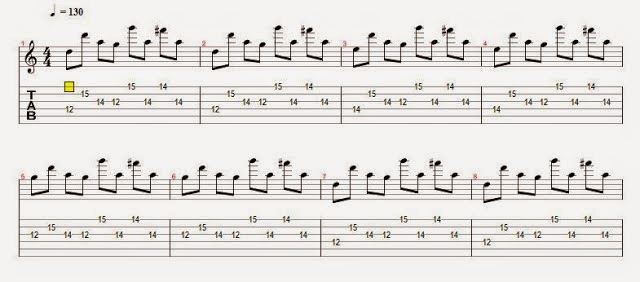
It’s an example of tab from Guns N’ Roses – Sweet Child O’ Mine. There are numbers, what does that numbers means ?

Those numbers shows the fret’s number on the guitar but remember to check the strings position.


And look at the another form below


It’s a tab from Nicolo Paganini – Sonata.

You can see there is a ‘0’ there, it means you play in open string or you just have to pick that string and not pressing any frets.


But how about this ?


The tab above is from Paul Gilbert’s song Boku Na Atama. Look at there is a number in fourth string but in first and second strings there just only a ‘0’ there. What does it mean ?


Next, look at this picture below.


It’s a tab from Guns N’ Roses – November Rain. Look at the words ‘full’, 1/2, a waving sign, umbrella, line on the 7 to 9. What does they mean ?

Full means that you have to bend until it makes a sounds 2 frets in front of it.

1/2 means that you have to bend until it makes a sounds 1 fret in front of it.

Waving sign means that you have to do vibrato on that note.

Umbrella sign means that you have to do legato technic.

The Line means that you have to do slide.

And if you see there is a ‘T’ it means you have to typing.


Okay I think that’s all the tips about reading guitar pro tabs. Hopes this would be useful to you.


Read more »

How to Write a Good Lyrics


Lyrics is the most essential thing in a song. If you ask somebody what he/she likes about his/her favorite song. There are 2 possibility : The vocal is good or the lyric is deep or matched with their emotion.

Lyric is the way you express the messages or meaning of your song. The messages is what the listeners wants to hear, they want to feel the emotion.

If you think writing lyrics is very hard to do, it isn’t. What makes it difficult is writing a lyrics that is perfectly fit into the listener’s heart.

Here is some steps that you can use to write a good lyric, you can use this steps as your ‘ace’ cards in writing lyrics for your songs.

1. Choose a theme

The first step is always started from the theme, or idea or concept. The more mature concept that you choose in the beginning, the more your song to be ‘alive’.

2. Create a structure of stories

If you skipped this step, your song may sound monotonic or boring. Making a structure is like building a foundation for you house. This structure will support your main theme. Songs that has a structure of stories, will have a strong identity.

3. Make a unique title

From the structure of stories, you can decide the title. Don’t underestimate the title of the song, because title has an important role in song.

Title is the way you can make your song looks unique than the other songs. If the other songwriter choose a ‘mainstream’ title, you could make a unique title and make your song be more interesting.

4. Write your lyrics

You’ve got the theme, you’ve created a structure, and you got a unique title. Now is the time to write down your lyrics. This is where you use your creativity. This is where you show that your songs is different than the other songs.

5. Try to create a visual, narrative, and descriptive lyrics

This is where the difference between you and other songwriter. Visual lyrics is a lyric that can make the listener can imagine your song like a film : action, love, or drama.

6. ‘Trim’ your lyric

The last part is making you lyrics ‘trimmed’. You can make your lyrics looks simple yet meaningful. Or you can make it long and has many messages or meaning.
Read more »

© Welcome To The Music Area !